


Digital marketing in 2026 is harder to measure than it was a few years ago. AI Overviews reduce clicks, zero-click behavior hides part of search demand, mobile-first buying continues to grow, and rising ad costs make every budget decision more accountable. These digital marketing statistics show where attention, traffic, and revenue signals are shifting now.


This report brings together fresh data from industry reports, consumer surveys, and search research to help teams make better channel decisions. Use it to compare SEO, paid media, content, video, AI search, mobile behavior, and conversion trends, then adjust budgets toward the channels that bring qualified demand rather than surface-level traffic.
- Search still carries significant weight in digital advertising, accounting for 40.9% of the global digital advertising market, while more than 75% of marketers expect to maintain or increase search and display ad budgets in 2026.
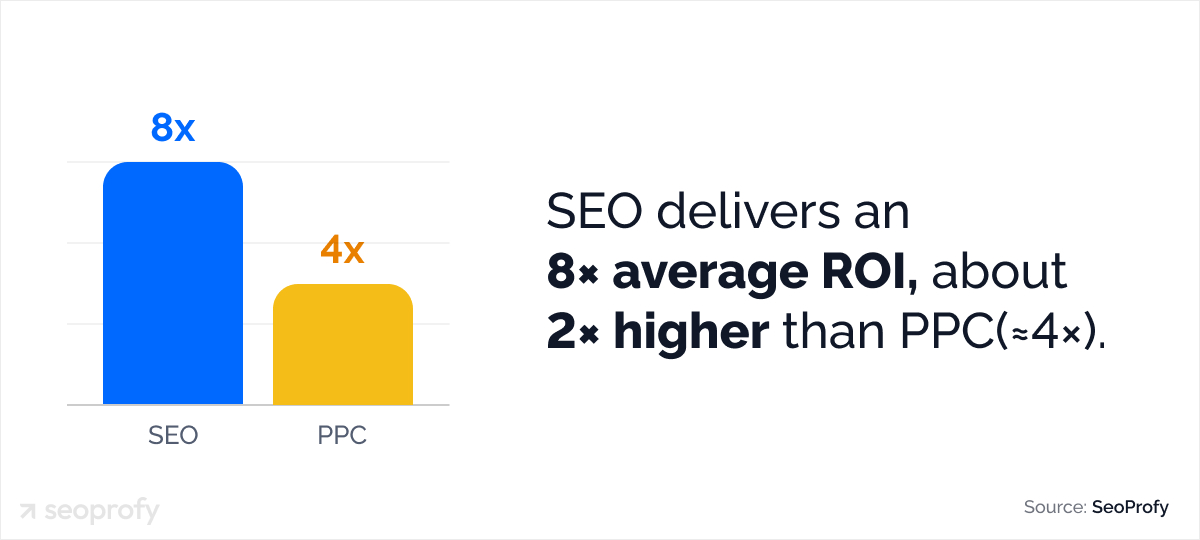
- Paid media still takes up a large share of marketing budgets, but SEO delivers stronger long-term returns, with an average ROI of 8x compared with around 4x for PPC.
- AI is changing organic search behavior. SparkToro/Datos data shows that 58.5% of U.S. Google searches and 59.7% of EU Google searches ended without an open-web click, while AI Overviews appear on roughly 48% of queries and reduce clicks on affected results.
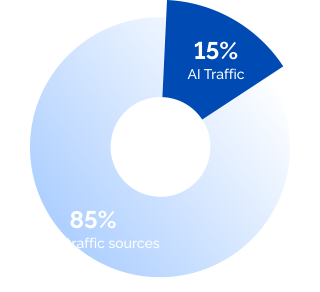
- AI-referred traffic behaves differently from traditional organic traffic: users tend to view fewer pages and bounce more often, even when they spend slightly more time on site.
- Mobile, local search, and reviews now shape high-intent decisions, with mobile generating 54.23% of global web traffic and reviews influencing 67% of post-search actions.
Digital Marketing Industry & Budget Statistics
In 2026, digital budgets are shifting toward channels that can prove demand, visibility, and revenue impact. More than 75% of marketers expect to maintain or increase search and display ad budgets, while 60% of small businesses plan to raise budgets, with content, digital advertising, branding, and sponsorships leading planned increases.
The general digital marketing statistics and online marketing statistics below cover global digital advertising, budgets, and team priorities:
Market Size and Ad Spend
These digital marketing growth statistics start with market size, CAGR, and demand shifts across regions and channels.
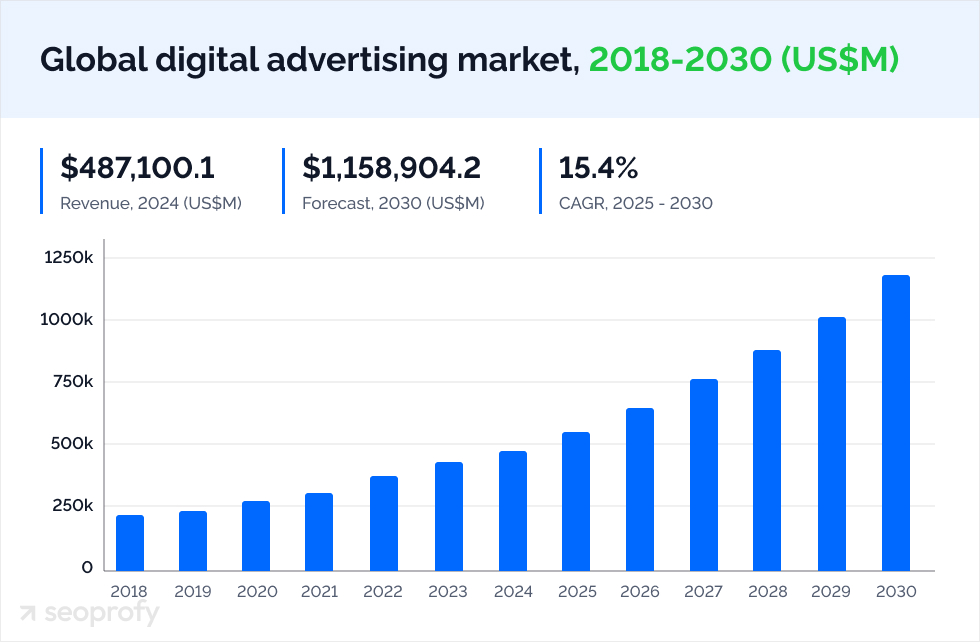
- The global digital advertising industry is projected to reach $1.16 trillion by 2030, with a CAGR of 15.4% from 2025 to 2030. (Grand View Research)
- Digital display is expected to expand at a 15.5% CAGR by 2030, outpacing search at 12.2%. Growth speed differs, market weight does not. Search accounts for 40.9% of the global digital advertising market. (Global Industry Analysts)
Budget Allocation and Channel Priorities
- In 2026, over 75% of marketers expect to maintain or raise budgets for search and display advertising. (HubSpot State of Marketing)
- In 2026, 60% of small businesses plan to raise budgets, focusing on content and digital advertising. (Clutch)
- Planned budget increases vary by channel. Content leads with 45%, digital advertising follows at 43%, branding stands at 41%, and sponsorships with strategic partnerships reach 35%. (Clutch)
- More than 50% of company budgets are directed toward paid media and technology investments. (Hostinger)
- 35% of marketers plan to raise influencer spend, while 42% expect to maintain current investment levels. (HubSpot)
Regional Growth, Skills, and Measurement
- Asia-Pacific is the fastest-growing regional digital marketing market and is expected to record above-average growth through 2032, with China’s platform ecosystem and India’s rapid smartphone, mobile data, and e-commerce adoption driving regional demand. (Fact.MR)
- By 2026, digital marketing jobs are forecast to increase by 10%, faster than the general labor market, with demand growing for roles such as digital marketing manager, analyst, and paid media specialist. (ZipRecruiter)
- The U.S. Bureau of Labor Statistics projects employment of market research analysts and marketing specialists to grow 7% from 2024 to 2034, much faster than the average for all occupations, with about 87,200 openings expected each year. (U.S. Bureau of Labor Statistics) (Forbes)
- AMA’s Future Trends in Marketing 2026 report warns that when AI is used mainly to cut roles instead of improving team capacity, workloads can increase, burnout can rise, and talent loss can weaken long-term delivery. (AMA’s Future Trends in Marketing 2026 report)
- A skills readiness gap persists across modern digital roles, with Deloitte reporting that 66% of managers see recent hires as unable to keep up with current and shifting job requirements. (Deloitte Insights)
- Responses from CMOs and marketing leaders across North America, the UK, and Europe show spend holding steady at around 7.7% of overall revenue in 2025. (Gartner)
- Keeping up with cross-platform buyer behavior remains difficult: 71% of marketers report challenges understanding how and where audiences interact with brands, based on HubSpot research. (HubSpot Marketing Overview)
- Supermetrics’ 2026 Marketing Data Report found that 45% of marketers still struggle with measurement, while 40% say proving ROI across channels is their biggest challenge. (Supermetrics)
- Data analytics, AI literacy, and general tech fluency are projected to remain among the most sought-after and rapidly expanding skill sets globally through 2030. Data analytics & interpretation remain a core demanded skill for marketers. (World Economic Forum Future of Jobs Report)
- 50% of marketers say they actively invest in content marketing. (SeoProfy)
- 37% of B2B companies still rely on cold calling. (Dux-Soup)
- Around 60% of businesses have already embraced AI for marketing purposes. (SeoProfy)
- Marketer focus in 2026 centers on lead quality and MQLs at 39%, followed by lead-to-customer conversion at 34%, digital marketing ROI at 31%, customer acquisition cost at 30%, and lead generation volume at 29%. (HubSpot).
What this means for 2026: Digital ad spending is still rising, but larger budgets do not automatically create stronger results. Teams need to connect digital marketing efforts across paid media, content, SEO, AI tools, and analytics to revenue goals instead of treating each channel as a separate activity.
What Do ROI & Conversion Statistics Show for 2026?
ROI and conversion statistics show which channels move users from interest to action. In 2026, digital marketing ROI goes beyond clicks or traffic; teams also need to track lead quality, attribution, personalization, and revenue impact across SEO, PPC, video, mobile messaging, and email marketing campaigns. Email marketing statistics also show why segmentation, subject line testing, and customer relationship management data still matter for conversion-focused teams.
The marketing statistics below compare how different channels perform when the goal is return, not visibility alone:
Email, PPC, and Attribution
- Email ranked among the top ROI digital channels in 2025. 30% of companies reported returns of $36–$50 per $1 spent, while 35% reported $10–$36 per $1. (Litmus)
- Top ROI performance is led by website, blog, and SEO at 27%. Email marketing records 22% and ranks 5th overall. (HubSpot)
- Social media shopping tools are cited by 23% of marketers as a major ROI driver, while 29% point to them as a leading use case for personalization and segmentation. (HubSpot)
- Mobile messaging is identified by 14% of marketers as a strong channel for personalization and segmentation, while 11% rank it among their highest ROI drivers. (HubSpot)
- 32% of companies use PPC as a channel to support direct-to-consumer sales. (Hostinger)
- Website visitors who see retargeting ads are 70% more likely to convert, making remarketing useful for bringing warm users back to purchase. (Invesp)
- Effective PPC optimization is associated with average returns of $2 per $1 of ad spend, equivalent to a 200% ROI. (WordStream)
- In 2026, video ROI is most often tracked through views (67%) and engagement (63%), followed by leads or clicks (52%) and direct sales (32%). (Wyzowl)
- Video content drives purchase intent for 85% of people. (Wyzowl)
- Multi-touch attribution usage by company size in 2025 is reported at 44%, 40%, 38%, 33%, 42%, and 73% across different size segments. (CaliberMind)
- The top barrier to effective marketing measurement in 2025 is data integration, cited by 65.7% of marketers. (CaliberMind)
Personalization and Conversion Benchmarks
- 90% of consumers are willing to share some form of personal data in exchange for more personalized service. (PwC)
- 53% of consumers say sharing personal information is worthwhile when it improves the smoothness of brand interactions. (PwC)
- Google’s methodology for estimating economic impact assumes that each $1 invested in Google Ads produces $2 in business revenue. (Google)
- SEO delivers an average return of 8x, while PPC generates a lower return at around 4x under comparable conditions. (SeoProfy)
- The absence of SEO often leads to heavier reliance on paid advertising, pushing ad spend increases to around 400%. (Lyfe)
- The overall Google Ads conversion rate averaged roughly 7.52% across industries in 2025. (WordStream)
- The average conversion rate for organic search across sectors is approximately 2.7%. (Thunderbit)
- Leads generated through SEO close at a rate of 14.6%, compared to 1.7% for outbound marketing efforts. (SeoProfy)
- Email marketing delivers an average conversion rate of approximately 2.6% across industries. (Ruler Analytics)
- Well-optimized landing pages can achieve conversion rates of up to 11.45% or more, significantly surpassing the average of 2.35%. (Tenet)
- 60% of consumers say they will likely become repeat buyers after a personalized shopping experience with a retailer. (Twilio Segment)
What this means for 2026: Conversion-focused teams should compare channels by revenue quality, not only traffic volume. SEO, email, paid search, video, and personalization can all support growth, but the strongest results come when attribution and customer data show which touchpoints actually move users toward purchase.
SEO & Organic Search Statistics
Organic search in 2026 is harder to evaluate by rankings alone. AI Overviews now appear on roughly 48% of tracked queries, and Ahrefs data shows that affected results can lose 34.5% to 58% of clicks. SparkToro/Datos zero-click data also shows that many searches end without an open-web click, so brands need visibility in classic rankings, AI summaries, citations, branded searches, and follow-up queries.
For SEO teams, the priority is to measure both visibility and the quality of the remaining clicks. According to SEO statistics, classic rankings still matter, but Google Search Central guidance, answer quality, page speed, mobile usability, schema, and topical authority now influence whether content gets cited, clicked, or ignored.
This also means the SEO strategy should move away from keyword stuffing and focus on providing useful answers, stronger technical signals, and content that earns visibility across both classic and AI-driven search results.
Search Market and Website Performance
- In 2025, Google dominated the global search market, with 89.62% of traffic across all devices, while Bing accounted for only 4.04%. (Statista)
- 72% of people use Google Search when looking for local businesses. (SeoProfy)
- Currently, around 1.3 billion websites exist globally, though just 15% are active, while 85% are inactive. (Siteefy)
- The top Google search result captures an average of 39.8% of all clicks. (Hostinger)
- When asked why people leave websites, 88.5% of respondents blamed slow loading speeds, and 73.1% cited poor mobile responsiveness. (SeoProfy)
- User behavior data shows that the average amount of time spent on an individual page view ranges from 52 to 54 seconds. (Forbes)
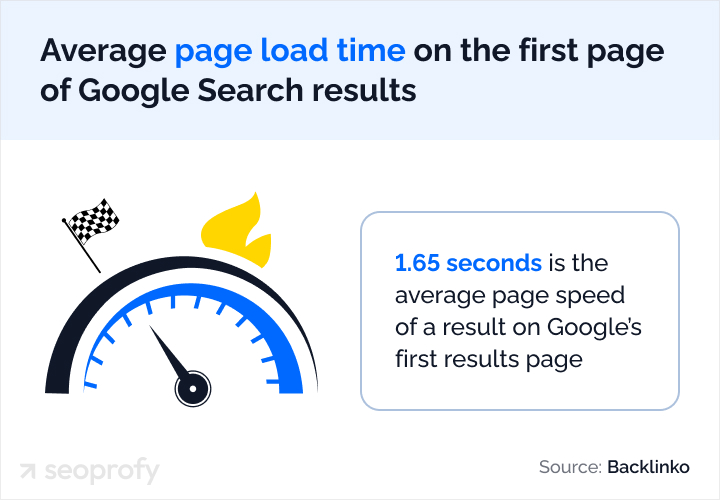
- Websites that appear first in search results typically load in 1.65 seconds. (Backlinko)
- According to HubSpot’s digital marketing stats, more than 92% of experts report current or planned adoption of SEO optimization for traditional and AI-based search engines. (HubSpot)
- Nearly 91% of senior SEOs said leadership asked about AI search visibility in the past year, showing that AI search reporting is becoming a board-level SEO concern. (Search Engine Land)
- Most marketers report that mobile devices generate more than half of their total annual traffic. (HubSpot)
- Focus areas that SEO professionals worldwide prioritize are content strategy/production (13.5%) and data analysis (10%). (Statista)
- Digital Applied’s 2026 zero-click search data found that clicks surviving AI Overviews convert 23% better, suggesting that lower click volume can still bring higher-intent visitors. (Digital Applied)
- Search engines are used by 32.9% of users aged 16+ to discover new brands, products, and services. (HubSpot)
- Search engines serve as the starting point for 68% of online activity. (Intergrowth)
- The SEO software market is projected to grow by USD 40.05 billion, at a CAGR of 21.3% between 2024 and 2029 (forecast period 2025–2029). (Technavio)
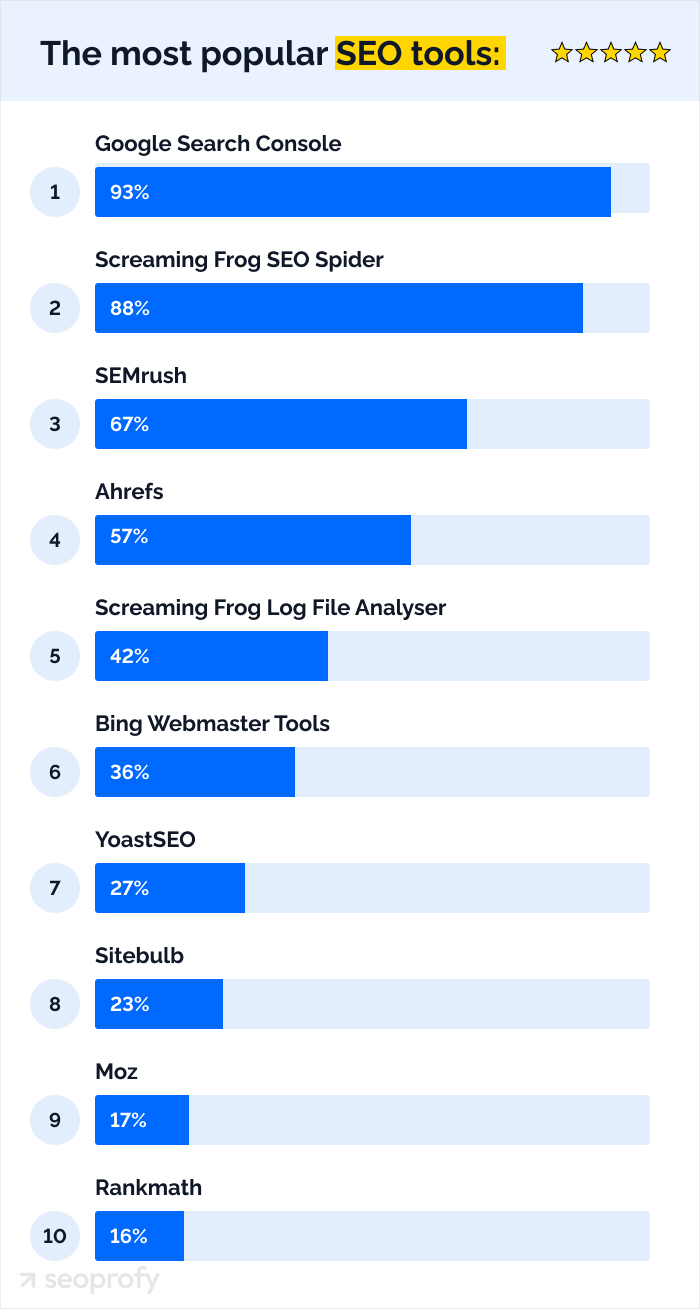
- The most popular SEO tools are Google Search Console, which is used by 93% of respondents; Screaming Frog, which is used by 88%; and Semrush, which is used by 67%. (Aira)
AI Overviews, Zero-Click, and CTR
- CTR for classic search links falls from 15% to 8% in sessions where an AI summary is present, a 47% decline in CTR. (Pew Research Center)
- Zero-click sessions occur on 26% of pages that include an AI summary, compared to 16% on classic SERPs. (Pew Research Center)
Search is still one of the strongest online channels, but AI Overviews are changing how organic traffic reaches websites. In 2026, rankings still matter, but SEO teams also need visibility across classic results, AI summaries, citations, and branded demand.
The digital marketing statistics below show how search behavior, organic visibility, and AI-driven SERPs are reshaping SEO performance:
| Search experience | Zero-click / click behavior | CTR impact | What it means for SEO |
| Classic Google SERP | 58.5% of U.S. Google searches and 59.7% of EU Google searches ended without an open-web click, according to SparkToro / Datos data. | Organic clicks still depend heavily on ranking, intent, SERP features, and device. | Classic rankings still matter, but they do not guarantee traffic on their own. |
| Google SERP with AI Overviews | SparkToro / Datos data shows that AI Overview searches can be much more zero-click-heavy, with up to 83% ending without an external click depending on the methodology. | Ahrefs reported a 34.5% CTR decline in 2025, followed by a 58% decline for top-ranking content on AI Overview queries. | Brands need to optimize for citations, answer quality, topical authority, and click-worthy follow-up intent. |
| Google AI Mode | SparkToro / Datos data shows AI Mode as the most zero-click-heavy search experience, with up to 93% of sessions ending without an external click. | Traditional blue-link CTR becomes much less useful when the user stays inside the AI interface. | Measure visibility, citations, branded searches, and assisted conversions, not traffic alone. |
- SparkToro / Datos data showed that 58.5% of U.S. Google searches and 59.7% of EU Google searches ended without a click to the open web in 2024. We use this as a zero-click baseline for comparing newer AI Overview and AI Mode search changes in 2025–2026. (SparkToro / Datos)
- Ahrefs found that AI Overviews reduced clicks to top-ranking content by 34.5% in 2025, and a later analysis showed a 58% decline in clicks on AI Overview queries. (Ahrefs)
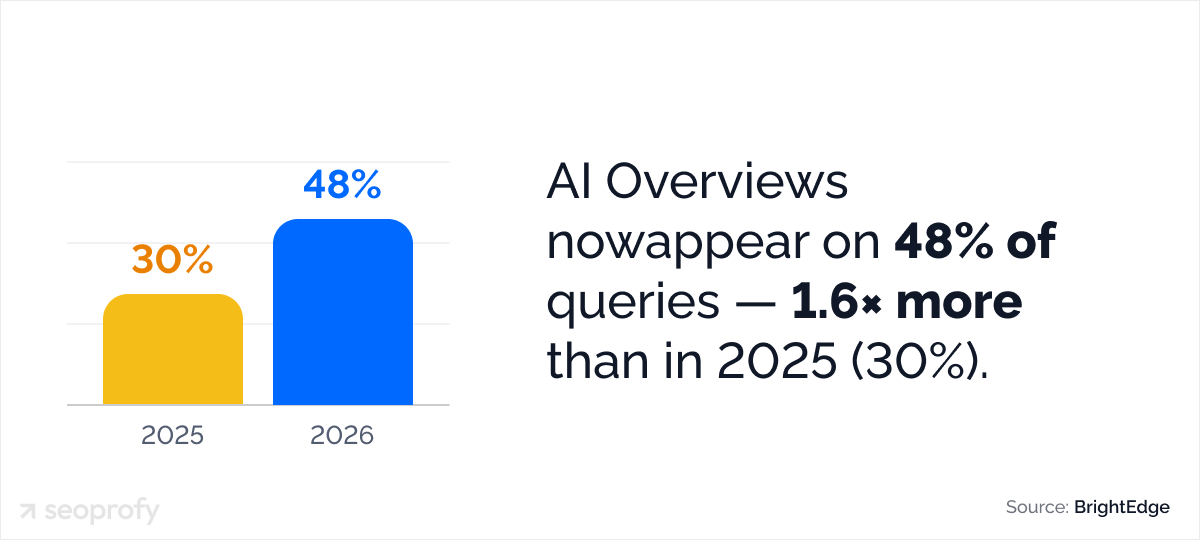
- BrightEdge data shows that AI Overviews triggered on approximately 48% of tracked queries in 2026, up from 30% a year earlier, a 58% increase. (BrightEdge)
What this means for 2026: Organic search traffic is becoming harder to measure through rankings alone. SEO teams should track classic rankings, AI Overview citations, zero-click exposure, branded search demand, and conversions from the smaller but often higher-intent click pool.
Content & Video Marketing Statistics
Content and video work best in 2026 when they help buyers make decisions faster. Content quality, relevance, and differentiation now matter more than publishing volume, while video helps explain products, build trust, and increase purchase intent. That is why teams need to measure not only traffic but also lead quality, engagement, assisted conversions, and the extent to which content supports the buyer journey.
The content marketing statistics below show how buyer research, brand awareness, lead generation, and trust now depend on useful, differentiated content.
Content Quality and Buyer Journey
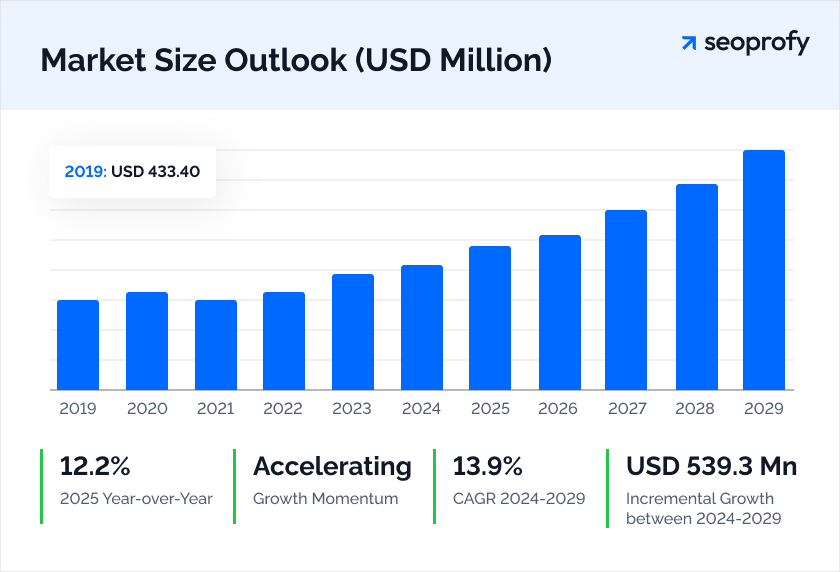
- The content marketing industry will grow by $539.3 million, with a CAGR of 13.9% from 2024 to 2029. (Technavio)
- B2B content marketing challenges are led by conversion-focused content at 40%, resource limits at 39%, and measurement issues at 33%. Other challenges include content quality and volume at 28%, differentiation at 24%, buyer-journey alignment at 23%, teamwork at 21%, audience insight at 20%, strategy at 16%, sales alignment at 15%, tech at 8%, and compliance at 6%. (CMI)
- According to Meetanshi digital marketing statistics, content marketing is part of the overall strategy for 73% of B2B marketers and 70% of B2C marketers. (Meetanshi)
- 63% of survey respondents say they turn first to a company’s website when searching for information, reinforcing it as the main content hub. (Isoline)
- Blog content length averages just under 1,400 words per post. (Orbit Media)
- In 2025, blog posts were the third most-used content format among marketers at 38%, following short-form video at 60% and long-form video at 38%. (HubSpot State of Marketing Report)
- 65% cite content relevance and quality as the primary driver of content marketing impact, with team skills and capabilities close behind at 53%. (Content Marketing Institute)
- 84% of B2B marketers said content marketing helped create brand awareness in the last 12 months, while 76% said it helped generate demand or leads. (Content Marketing Institute)
- Among B2C marketers, 84% rely on stronger content quality to compete more effectively. (Adam Connell)
- 35% of organizations operate without a dedicated content marketing team. Team sizes of 2–5 people are most common at 32% overall, while 23% operate with a single dedicated content marketer. Larger teams are far less typical, with only 6% reporting 6–10 people and 4% reporting 11+ dedicated content roles, skewing heavily toward large enterprises. (Search Endurance)
- 42% of customers say impersonal content causes frustration. (Ecommerce Bonsai)
- An average of 4.5 content assets are consumed before responders initiate contact with a supplier. (Isoline)
Video Adoption and Buyer Intent
The video marketing statistics in this section show how video supports product education, purchase intent, ROI tracking, and brand communication in 2026.
- The average individual watches online video for roughly 17 hours each week. (Social Shepherd)
- 61% of B2B content marketers report higher investment in video in 2025 compared to the previous year. (Statista)
- 67% of marketers who do not currently use video plan to start video marketing in 2026, while 33% do not plan to adopt it. Year over year, the share dropped by 1%, while overall intent to adopt video marketing stayed nearly unchanged. (Wyzowl)
- Short-form interactive videos can increase sales and conversions by up to 80%, making the format useful for product education and purchase intent. (Firework)
- Video-enhanced emails deliver an average conversion rate of 5.25%. (Backlinko)
- 84% of consumers say they want to see more videos from brands in 2026, showing that video remains a preferred format for product education and brand communication. (Wyzowl)
- Purchase intent rises for 88% of consumers after watching a video about a product. (Zebracat)
- YouTube advertising exposure covered 45.5% of the global online population in early 2025. (DataReportal)
- More than half of global B2B buyers, at 55%, consider video the most valuable form of content. (Isoline)
What this means for 2026: Content teams should prioritize useful, differentiated assets over publishing frequency alone. Video, expert-led content, and buyer-focused resources can support brand awareness, search visibility, lead generation, and website traffic when they are tied to a clear content marketing strategy.
How Is AI Changing Digital Marketing Statistics in 2026?
AI is already widely integrated into marketing work in 2026, but mostly at the task and workflow level rather than across the full strategy. MoEngage data shows that only 4.6% of B2C marketers were not using AI as part of their omnichannel strategy in 2025, while HubSpot reports that 80% of marketers use AI for content creation, 75% for media production, and 93% for administrative task automation.
At the same time, AI maturity is still uneven. Semrush found that only 22% of marketers say their SEO and AI search efforts are fully integrated across strategy, execution, and reporting. This gap shows that many teams use AI regularly but still need clearer workflows, better measurement, and stronger AI search strategies to turn adoption into business results.
The AI marketing statistics below show where adoption is strongest, how teams use AI in daily work, and why brands need to adapt content and SEO strategies to rank in AI Overviews and other LLM-driven search experiences.
This also makes LLM SEO and generative engine optimization important for teams that need visibility beyond classic search results.
AI Adoption and ROI
- MoEngage’s omnichannel research found that only 4.6% of B2C marketers were not using AI as part of their omnichannel strategy in 2025, down from 22.8% in 2024. (MoEngage)
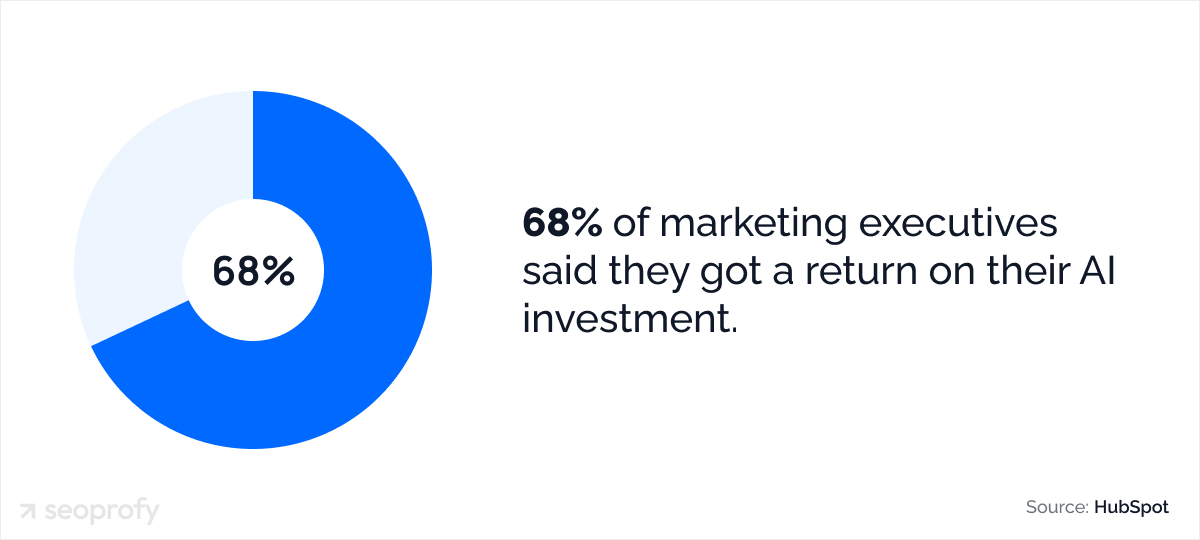
- 68% of executives said they got a return on their AI investment. (HubSpot)
- 80% of marketers currently use AI for content creation, while 75% use it for media production. (HubSpot State of Marketing Report)
- 93% of marketers report using automation for administrative tasks such as scheduling, note-taking, and documentation, while about 92% use automation for data analysis and reporting. (HubSpot State of Marketing Report)
AI Search and LLM Visibility
- 85% of marketers say AI has changed their search strategy, with 32% saying it has significantly evolved and 53% reporting some adjustments. (Semrush)
- Only 22% of marketers say their SEO and AI search efforts are fully integrated across strategy, execution, and reporting. (Semrush)
- About 73% of consumers express trust in content produced by AI. (SeoProfy)
- 56% of marketers say the internet is now saturated with AI-generated content, while 65% report that consumers are becoming better at recognizing it. (HubSpot)
- 66% of consumers estimate that AI will overtake traditional search within the next five years. (Search Engine Land)
- Nearly 24% are actively considering updates to their SEO strategy to account for generative AI in search. (HubSpot)
- AI is already present in email marketing for 39% of marketers, and an additional 25% report plans to adopt AI for future email campaigns. (Backlinko)
- According to Salesforce digital marketing statistics, 71% of experts say their strategies for content creation and search visibility have changed due to generative AI. (Salesforce)
- ChatGPT most often pulls from structured sources, as 61% of cited pages rely on schema markup. (SeoProfy’s ChatGPT ranking guide)
- As consumers shift toward AI tools, close to 30% of marketers say their search traffic has dropped. (HubSpot)
- 65% of marketers say everyday AI use has shifted consumer expectations toward faster and more personalized responses. (HubSpot)
- As teams try to earn LLM citations, data shows that links placed directly in AI summaries receive clicks in only around 1% of visits. (Pew Research Center)
- In January, 91.3% of queries triggering an AI Overview were informational, but by October this dropped to 57.1% as commercial and transactional queries gained share. AI Overviews appeared in just 0.74% of navigational searches in January, but that figure climbed to 10.33% by October. (Semrush)
- Among companies already using generative AI, just 1% believe their investments are already delivering their full potential. (Digital Marketing Institute)
- Internet users referred by AI platforms visit about 4 pages on average, compared with higher engagement from search visitors (+1.2 pages) and overall site traffic (+1.5 pages). (Ahrefs)
- AI users view fewer pages per unit of session time, averaging 2.27 compared to search and overall traffic, while at the same time spending about eight seconds longer on the site. Despite the longer time spent, AI-referred visitors show weaker engagement signals, with bounce rates 4.1% higher than search users and 5.4% higher than the overall site average. (Ahrefs)
- Reddit threads, YouTube demos, and forum posts absorb roughly 33% of the traffic left behind by AIO. (Growth Memo)
What this means for 2026: AI now plays a larger role than productivity alone. Brands need to measure how AI affects search visibility, content workflows, lead quality, reporting, and customer expectations, rather than treating AI use as a separate experiment.
How Are Consumer Behavior, Devices & Local Search Changing in 2026?
Consumer behavior in 2026 is shaped by mobile access, mobile marketing, AI-assisted discovery, social media usage, online reviews, and local intent. People may start with Google, Maps, a social media platform, AI tools, or review sites, so marketers need to optimize for every touchpoint where trust is built before a click, visit, or purchase.
Mobile experience also affects retail e-commerce sales, as shoppers compare products, reviews, and local availability before buying.
The digital marketing statistics below show how device choice, local SEO, social proof, and connected habits affect buying decisions:
Internet Access and Mobile Behavior
- As of April 2026, 6.12 billion people use the internet worldwide, equal to 73.8% of the global population. (DataReportal)
- BrightLocal’s 2026 survey found that 97% of consumers read reviews for local businesses. (BrightLocal)
- DataReportal’s global overview shows that 96.2% of internet users go online via a mobile phone at least some of the time, showing how strongly mobile users now shape global web traffic. (DataReportal)
- Global social media user identities reached 5.79 billion in April 2026, equal to 69.9% of the global population and up 5.4% year over year. (DataReportal)
- Average order value is lower on mobile than desktop, with mobile orders typically ranging from $90 to $110, compared with $140 to $175 on desktop. (ElectroIQ)
- As of December 2025, mobile devices account for 54.23% of worldwide web traffic, while desktop usage makes up the remaining 45.77%. (StatCounter)
- Branch’s Mobile Growth survey found that app users spend $3.30 for every $1 spent by non-app users, showing that app behavior can be more than 3x stronger than non-app behavior in mobile commerce. (Branch)
- HubSpot digital marketing statistics show that 47% of B2B and 47% of B2C marketers have seen increased web traffic from AI-driven search, while 19% are actively building SEO strategies for generative AI. (HubSpot)
- As of June 2025, only 5.6% of desktop search traffic in the US flows to AI-based LLM search, compared to 94.4% going to classic search platforms. (Datos, reported by WSJ)
- Concerns around data privacy remain high among EU online shoppers, with 71% worried about personal information being collected without clear awareness or consent. Cookie control is another friction point, as 58% say they find it difficult to manage or block tracking technologies. In addition, 49% fear being pressured into paid subscriptions when they refuse tracking or behavioral analysis. (Ipsos)
- Trust grows when people know how their data is handled, and this clarity directly affects their readiness to share personal information. Separately, broad acceptance of regulation stands out, with 87% saying strong privacy laws make engagement with AI tools feel safer. (Cisco)
- Google research cited by Volusion found that 73% of consumers will switch from a poorly designed mobile site to one that makes purchasing easier. (Volusion / Google research)
Reviews, Maps, and Local Discovery
- Maps-first behavior is now a meaningful part of local search, with 15% of users starting directly in Google Maps and map products overall accounting for about 20% of default local-search platforms. After a local search, user actions skew strongly toward validation and planning, as 67% often or always read reviews, 56% check the accuracy of business information, and 49% plan a route before taking the next step. (BrightLocal)
- AI is beginning to appear as a default option for general search, with 5% of users saying ChatGPT is their primary search platform, a figure that rises to 10% among Gen Z. Beyond default preference, generative AI already plays an active role in search behavior, as 40% of users report actively using generative AI during their search experiences. (BrightLocal)
- 74% of people consult two or more sources when reading reviews, while 27% rely on a single source only. Use of AI for review discovery remains limited, with just 6% saying they used tools like ChatGPT to find reviews, a decline compared with the previous year. (BrightLocal)
Social Platforms and Brand Discovery
- In 2026, social media ads rank as the third most important source of brand awareness globally, after search and TV ads. They are especially influential among younger demographics. (We Are Social)
- People aged 16–34 are the most active average social media users globally, giving social media marketers a faster path from exposure to engagement for younger audiences. (DataReportal)
- YouTube reaches the widest age range, with strong penetration across the 18–44 segment, which makes it effective for digital marketing campaigns focused on both brand awareness and consideration. (DataReportal)
- According to Statista social media statistics 2026, Facebook is the most popular social media platform among marketers, with around 86% of marketers worldwide using it in 2026. (Statista)
- Hootsuite social media marketing statistics show that average engagement rates on social media range from 1.4% to 2.8%, depending on the platform. (Hootsuite)
What this data means for 2026: Mobile access, social media usage, online reviews, and local search behavior now shape how people compare brands before they contact a business. Marketers should treat device experience, review visibility, Google Maps presence, and trust signals as part of one connected conversion path. Voice search, AI tools, and Maps also influence how users discover local businesses before visiting a website.
Final Thoughts
The latest digital marketing statistics show that 2026 is not the time to choose one channel and ignore the rest. Search still drives high-intent discovery, but AI overviews, zero-click behavior, video, mobile browsing, social media, local platforms, and online reviews now shape how people compare brands before they click or buy.
The strongest digital marketing strategy connects these signals instead of treating them separately. SEO remains important because it supports long-term visibility and stronger digital marketing ROI, but teams also need to measure AI search visibility, content quality, paid media efficiency, mobile experience, and trust signals across the full buyer journey.
They also need stronger first-party data as third-party cookies become less dependable. For more digital marketing statistics, teams should keep checking source data by channel instead of relying on broad averages.
For businesses, the next step is practical: review where traffic, leads, and conversions actually come from, then adjust budgets to prioritize channels that drive qualified demand. SeoProfy helps companies improve technical SEO, content, local search, ecommerce visibility, and AI-driven search performance with a data-led process built around measurable growth.

As a Content writer at SeoProfy, Hanna Zhytnik creates SEO content grounded in research, data, and ongoing hypothesis testing. With more than 5 years of experience across B2B, SaaS, and ecommerce, she brings both breadth of knowledge and a sharp focus on modern search. Her strength lies in turning complex experiments into clear explanations, bridging the gap between deep SEO practice and accessible content.