

We’ve put together this list of local SEO statistics to show you how the field is changing in 2026. Every stat comes with a link to the original source, so you can always double-check the data yourself.


Our list covers trends around Google Business Profile performance, reviews, conversions, mobile searches, and ranking factors. We’ve also added new data on how AI affects local visibility and how businesses are using it to give you a look at where local search is heading next.
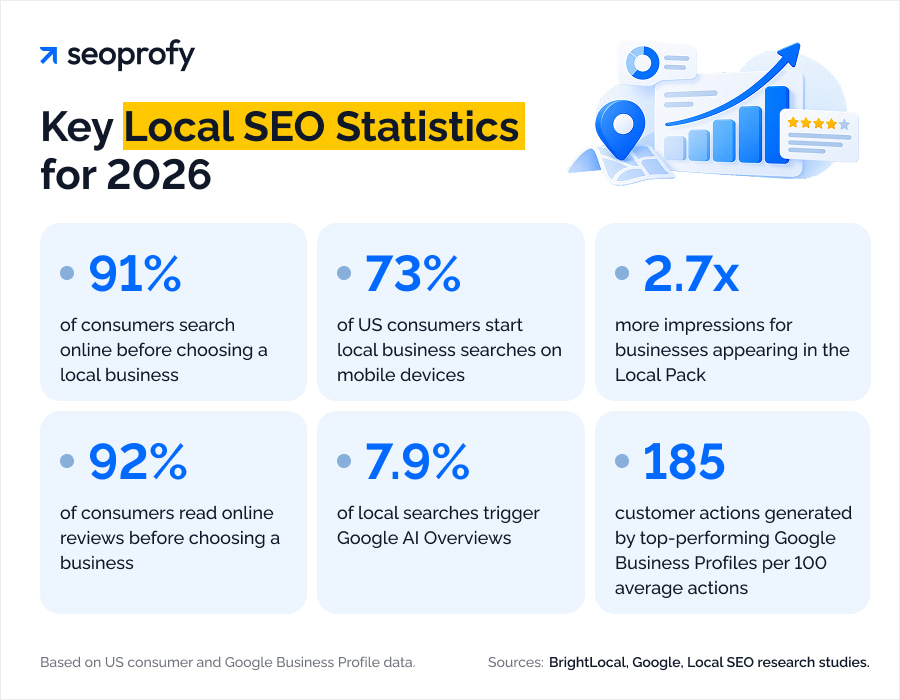
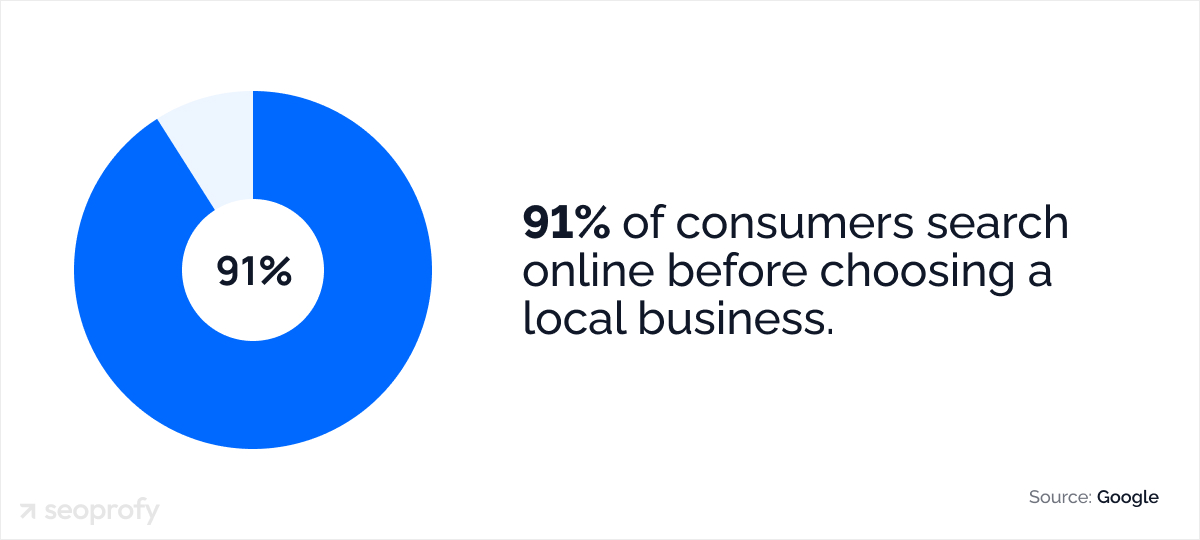
- 91% of consumers search online before choosing a local business, which reinforces the importance of local SEO for customer discovery.
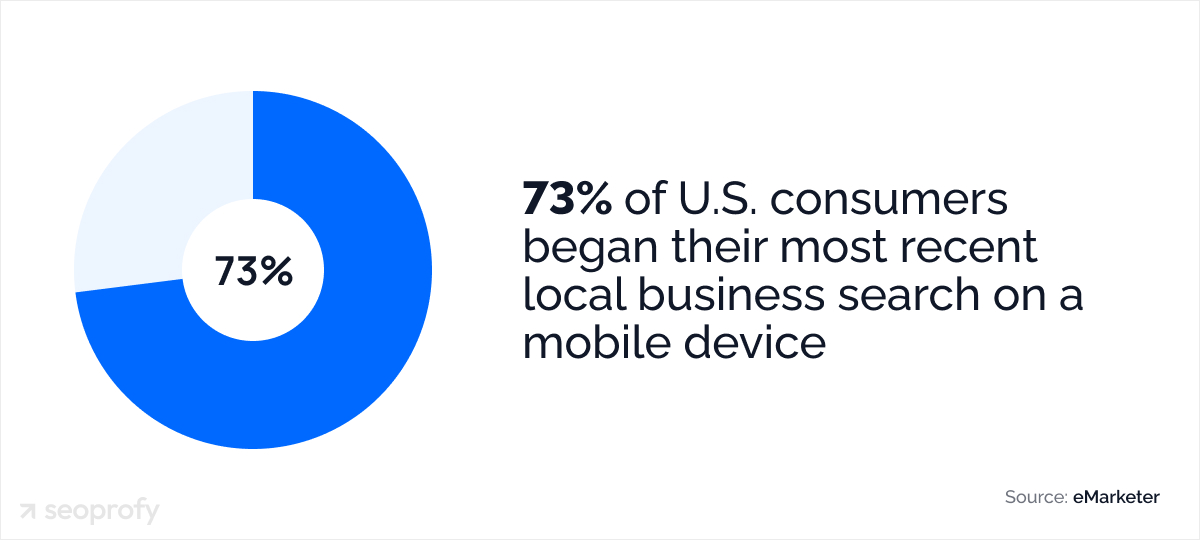
- 73% of U.S. consumers started their most recent average local business search on a mobile device.
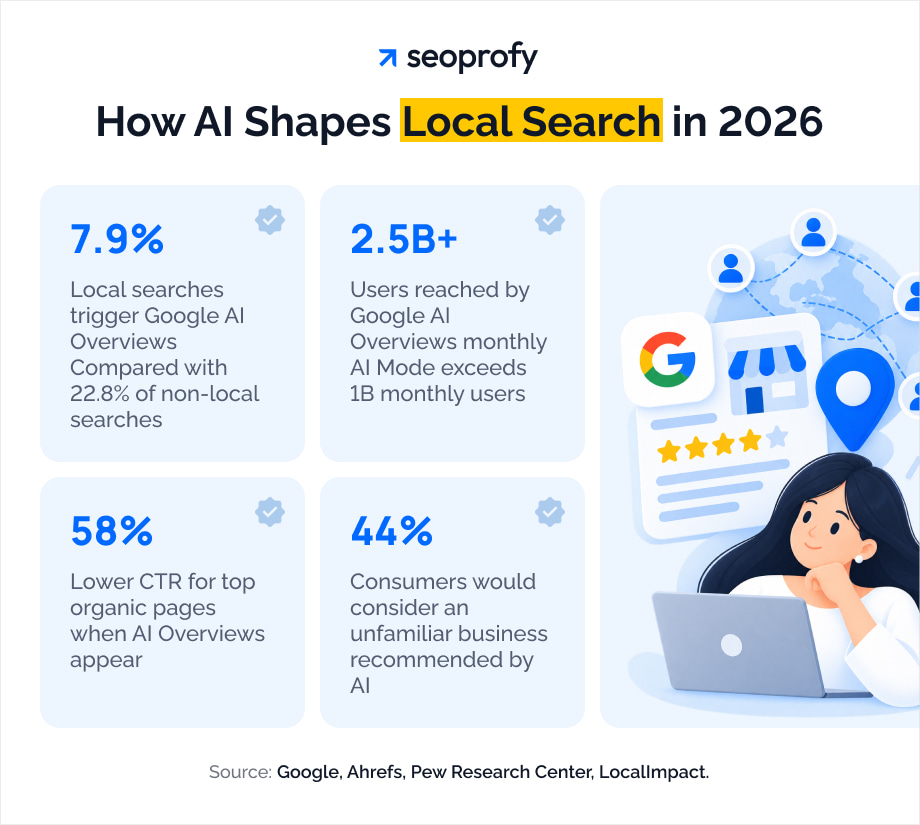
- Only 7.9% of local searches trigger a Google AI Overview, compared with 22.8% of non-local searches, but AI visibility is already becoming relevant to local SEO.
- Businesses in the Local Pack receive 2.7 times more impressions than similar local businesses elsewhere on the first page, while impressions drop by 52% for positions 4–10.
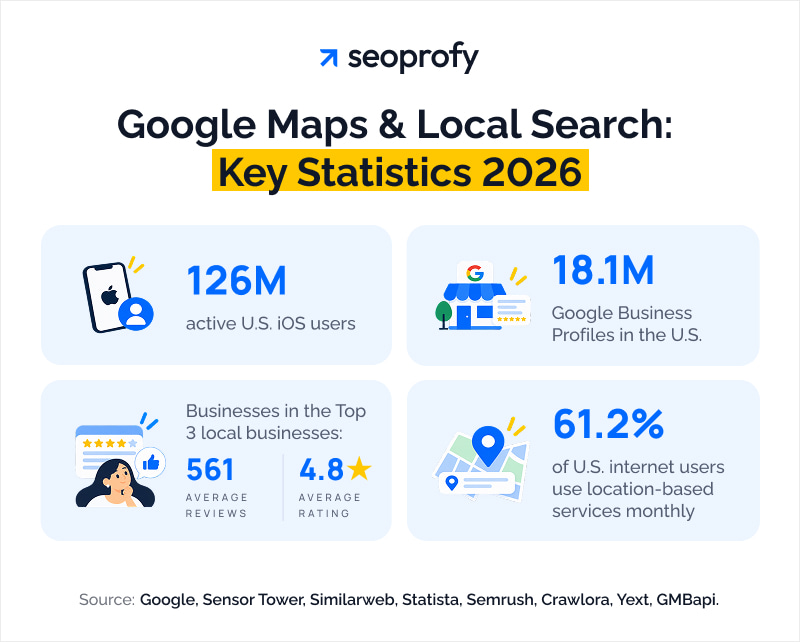
- Businesses in the top three local positions averaged 561 Google reviews and a 4.8-star rating.
- The best-performing 10% of Google Business Profiles generate about 185 customer actions for every 100 generated by an average location.
- 92% of consumers read online reviews, and 78% say a thoughtful response to a negative review makes them more likely to trust a business.
General Local Search Statistics
A 2026 Yext survey found that 59% of U.S. consumers start their local search on Google, compared with 40% who start on social media. Local businesses now need to stay visible across several discovery and verification channels, with accurate information wherever customers research their options.
Strong local SEO helps businesses reach customers at the point when they are actively comparing nearby options. Here are local SEO statistics that back this up:
- 91% of consumers search online before choosing a local business. (Google)
- 56% of business owners manage local SEO themselves, 25% have another team member handle it. (Semrush)
- 70% of local businesses have performed a local SEO audit at some point. (Semrush)
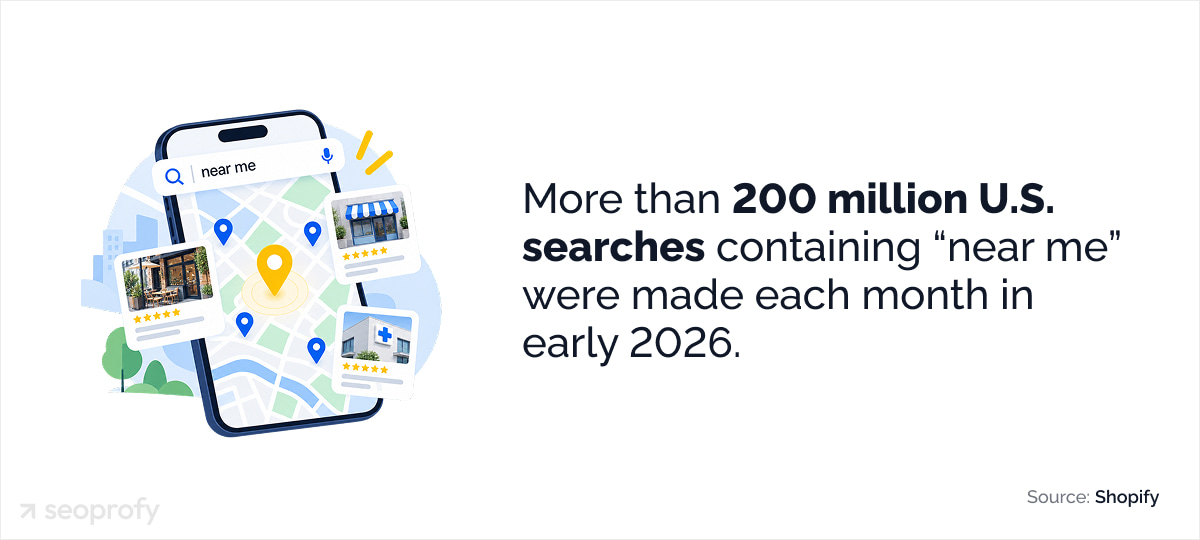
- More than 200 million U.S. searches containing “near me” were made each month in early 2026. (Shopify)
- “Food near me” generated 21,995,272 Google searches in the 30 days leading up to August 2026, while “restaurants near me” generated 11,406,805. (Glimpse)
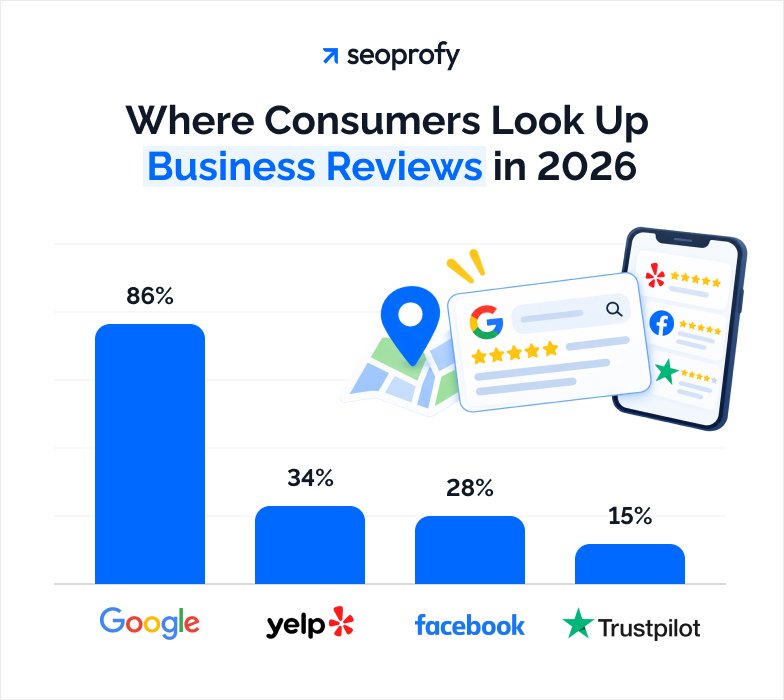
- Where consumers look up business reviews in 2026: Google: 86%, Yelp: 34%, Facebook: 28%, Trustpilot: 15%. (LocalImpact)
- 24% of consumers plan to shop and dine at local businesses more often throughout 2026. (Square)
Mobile Local SEO Statistics
Mobile is now an important part of local SEO: smartphones accounted for 65.39% of worldwide web traffic in July 2026. That’s why any local SEO strategy should always include mobile optimization. Businesses need to optimize for local mobile searches so that users can easily find their website online and access details like address, services, opening hours, and contact number.
Google also uses the mobile version of a site’s content for indexing and ranking, so mobile usability is relevant to search visibility as well as user experience.
- 73% of U.S. consumers began their most recent local business search on a mobile device, compared with 19% on a computer and 8% on a tablet, showing why mobile remains central to local SEO. (eMarketer)
- Among consumers aged 30–44, 86% started their most recent local business search on mobile. The figure was 77% among 45–60-year-olds and 71% among 18–29-year-olds. (eMarketer)
- Google held 95.82% of the worldwide mobile search engine market in July 2026. (Statista)
- Mobile accounted for more than 50% of global web visits in Q1 2026, while desktop still represented over 70% of total time spent on the web. This suggests that users increasingly browse on mobile but turn to desktop for longer, more in-depth sessions. (Sensor Tower)
- 84% of the world’s top 500 websites load more slowly on mobile than on desktop, and only 44% pass Core Web Vitals on mobile compared with 64% on desktop. (PageSpeed Matters)
- 53% of mobile origins passed all three Core Web Vitals in June 2026, compared with 59% of desktop origins. (HTTP Archive)
AI Overviews & Generative Search Statistics
Google’s AI-generated search features are now part of local discovery, but they have not replaced traditional local results. In March 2026, 47% of U.S. adults said they had used AI to find a local business in the previous month. (Yext)
Visibility in generative search also depends on the information businesses publish and maintain. An analysis of 155.5 million location-grounded AI citations found that 80% pointed to websites or listings a brand can influence.
Keeping Google Business Profile data accurate and publishing clear location, service, and business information should therefore remain a core part of local SEO management since it supports visibility across both traditional and AI-powered search.
- Only 7.9% of local searches triggered a Google AI Overview, compared with 22.8% of non-local searches. (Ahrefs)
- Google AI Overviews now reach more than 2.5 billion users each month, while AI Mode has surpassed 1 billion monthly users. (Google)
- When an AI Overview appears, the top-ranking organic page sees an average click-through rate about 58% lower than expected without an AI Overview. (Ahrefs)
- 38% of consumers use AI specifically to research local services, while 70% say AI has helped them decide what to buy or which business to choose multiple times. (LocalImpact)
- 44% of consumers would consider a business they had never heard of if an AI tool recommended it. When AI and reviews conflict, 41% trust the reviews. (LocalImpact)
- AI Mode queries have more than doubled every quarter since launch, and the average AI Mode query is 3 times longer than a traditional Google Search query. (Google)
- 60% of U.S. adults say they read AI-generated summaries at the top of search engine results. (Pew Research Center)
- Business websites accounted for nearly 60% of Gemini citations across 1,487 local search queries, while Gemini recommended the same top business in repeated searches only about 7% of the time. (Search Engine Land)
Google Maps and Google 3-Pack Statistics
In local SEO, gaining visibility is not an easy task, especially for small businesses. But showing up in Google 3-Pack can definitely speed up this process. A map pack is a group of three top results from Google Maps that appear alongside regular listings.
This shows up when a user adds a location to their search query, for example, “hotel New York” or “pet-friendly restaurants Long Island.”
As you might have guessed, businesses listed in the Google 3-pack get way more attention than those that aren’t. To be more specific, they get 126% more traffic and 93% more actions, like calls and website clicks, compared to those ranked between 4 and 10.
This puts into perspective just how important it is for your company to get a spot in those search results. On that note, let’s take a look at other local SEO stats related to Google Pack:
- Google Maps now draws on information from more than 300 million places and a global community of more than 500 million contributors. (Google)
- Google Maps averaged more than 126 million active U.S. iOS users during Q4 2025. (Sensor Tower)
- Google Maps recorded roughly 350,000–390,000 weekly U.S. iOS downloads in Q4 2025, compared with about 110,000–150,000 for Waze. (Sensor Tower)
- Google Maps ranked as the #1 Travel & Local Android app in the U.S. on August 12, 2026. (SimilarWeb)
- Google Maps ranked fifth among all U.S. smartphone apps by audience reach in January 2026. (Statista)
- Businesses appearing in Google’s local pack had an average of 993 backlinks from 216 referring domains. (Semrush)
- A July 2026 dataset identified 18,130,566 live Google Business Profile listings across the U.S., illustrating the scale of competition within Google’s local ecosystem. (Crawlora)
- Businesses in the top three local positions averaged 561 Google reviews and a 4.8-star rating. (Semrush)
- Google Maps users published more than 1 billion reviews and suggested 80 million updates to business hours, contact details, and other information in 2025. (Google)
- Businesses in the Local Pack receive 2.7 times more impressions than similar businesses ranking elsewhere on the first page; views fall by 52% for positions 4–10. (Yext)
- In Q2 2026, U.S. mobile Google Maps impressions increased 30.4% year over year, compared with 3.2% growth for desktop Maps impressions. (GMBapi)
- 61.2% of U.S. internet users used online maps, parking apps, or other location-based services each month in Q2 2025. (Statista)
Google Business Profile Statistics
Your Business Profile is one of the central pieces when building your presence. It shows up as a listing in local searches and gives users an overview of all the key local business information online. Many potential customers will use your Google profile to contact you, check working hours, or get directions.
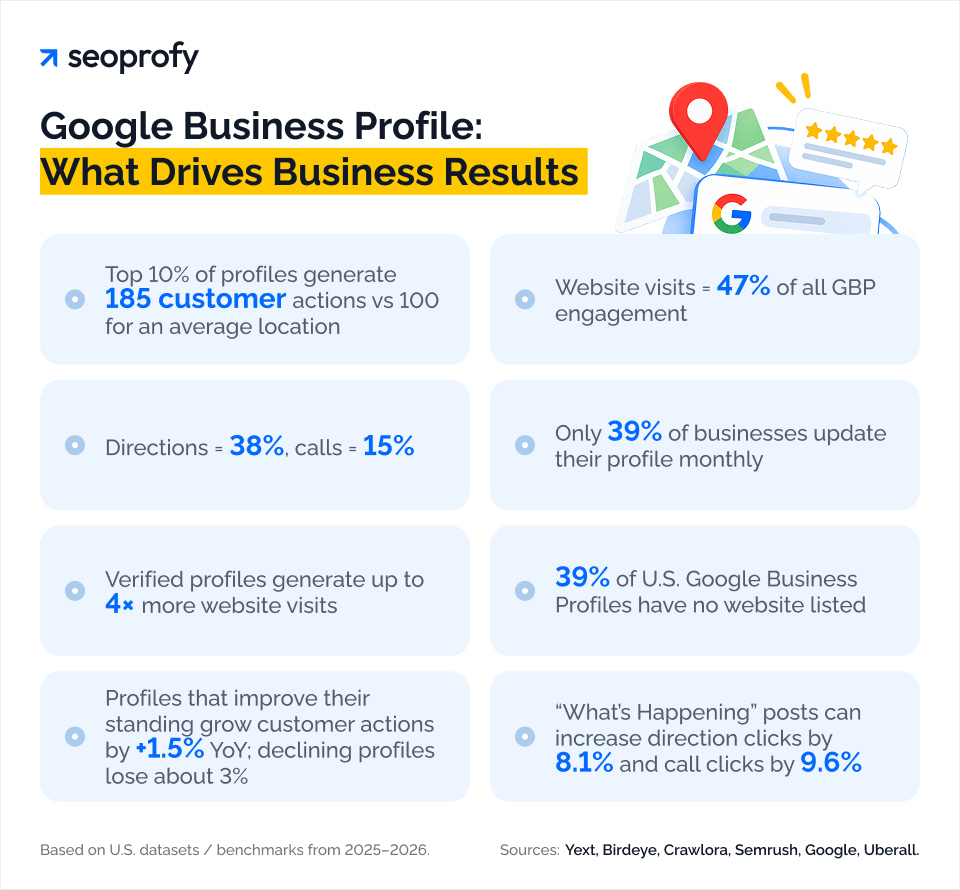
- Across 600,000 U.S. locations, the best-performing 10% of profiles generated about 185 customer actions for every 100 generated by an average location, while the lowest-performing 10% generated about 60. (Yext)
- Website visits account for 47% of Google Business Profile engagement, followed by direction requests at 38% and phone calls at 15%. (Birdeye)
- 39% of the 18.1 million U.S. Google Business Profile listings analyzed in July 2026 had no website listed. (Crawlora)
- Only 39% of businesses update their Google Business Profile every month. (Semrush)
- Google removed more than 13 million fake business profiles and blocked 79 million inaccurate or unverified map edits in 2025. (Google)
- 76% of profiles in Birdeye’s 2025 benchmark were verified, and verified profiles generated up to four times more website visits than unverified profiles. (Birdeye)
- Among initially weak profiles, locations that improved their competitive profile standing grew customer actions by about 1.5% year over year, while those that declined lost about 3%. (Yext)
- Google Business Profile data can now be tracked through seven core metrics in Google Analytics: interactions, calls, bookings, directions, website clicks, messages, and menu clicks. (Google)
- Only 8.4% of the 18.1 million U.S. Google Business Profiles analyzed in July 2026 had both a rating of at least 4.5 stars and 50 or more reviews. (Crawlora)
- Google data cited in August 2026 shows that when a “What’s Happening” module is triggered for a same-day event, deal, or special, direction clicks rise by about 8.1% and call clicks by 9.6%. (Uberall)
Local Search Rankings Statistics
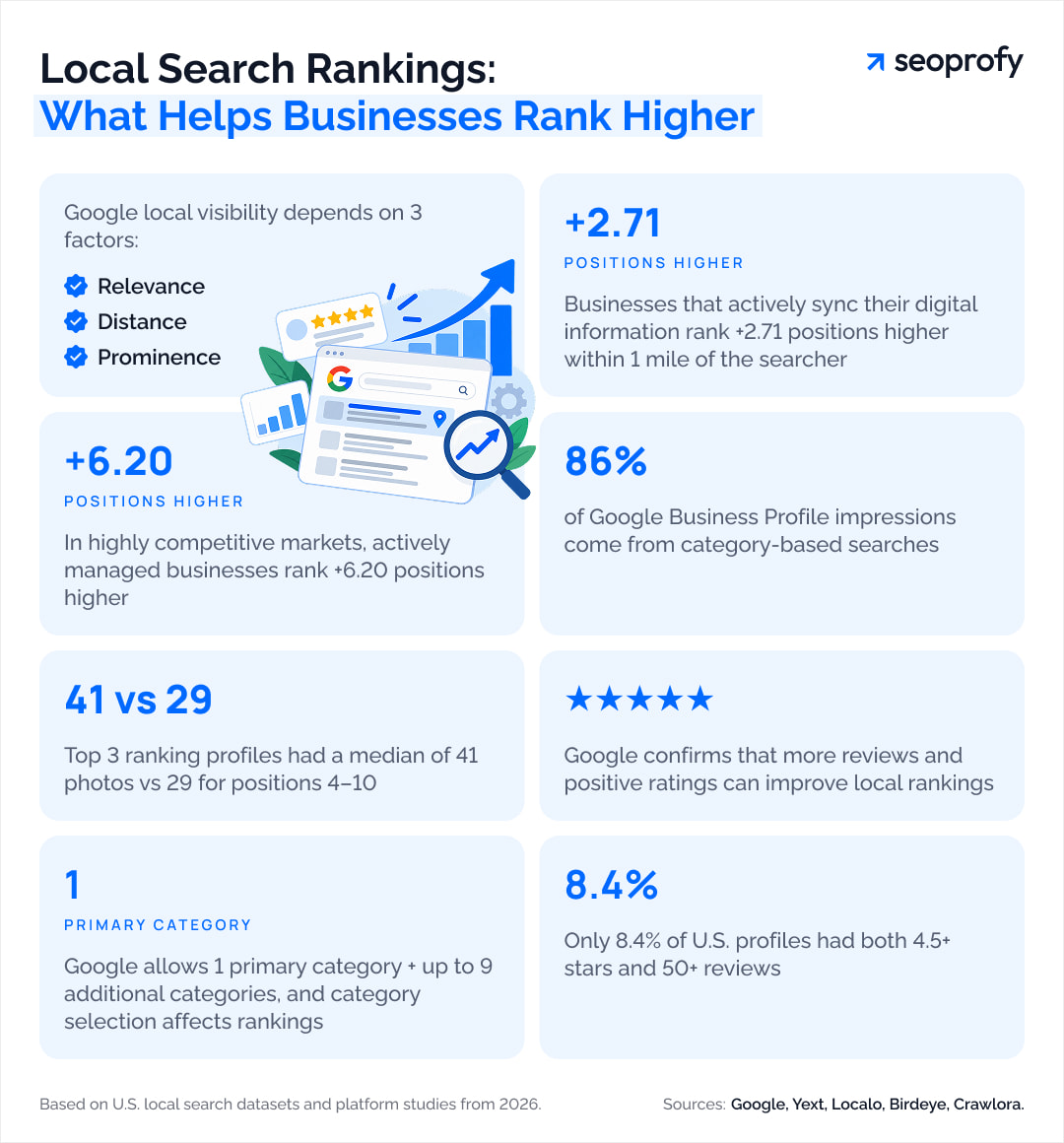
Google says local visibility is mainly determined by three core local SEO ranking factors:
- Relevance: How closely a business profile matches the local intent behind the customer’s search.
- Distance: How far the business is from the customer or specified location.
- Prominence: How well known the business is, based partly on signals such as links, reviews, and ratings.
A business cannot control how close each searcher is, but a strong local SEO strategy can improve many of the relevance and prominence signals Google evaluates. Complete business data, appropriate categories and services, consistent location information, reviews, locally relevant website content, and authoritative links provide Google more information to evaluate when deciding which businesses to surface.
- Across 21.6 million local search results, businesses actively synchronizing their digital information ranked an average of 2.71 positions higher within one mile of the searcher. (Yext)
- GBPs ranking in the top three had a median of 41 photos, compared with 29 for positions 4–10 and 24 for positions 11–20, based on a 2026 analysis of 16,098 profiles. (Localo)
- 86% of Google Business Profile impressions come from category-based searches rather than branded searches, reinforcing the importance of accurately describing what the business offers. (Birdeye)
- Google explicitly states that more reviews and positive ratings can help a business rank higher in local search. (Google)
- In highly competitive markets with 100 or more businesses targeting the same searches, actively managed businesses ranked an average of 6.20 positions higher. (Yext)
- 38% of businesses ranking in the top three local positions included the target keyword in their Google Business Profile business name. (Semrush)
- Google added 54 new Business Profile attributes in April 2026, expanding the information it can use to match businesses with feature-specific local searches. (GMBapi)
- Google allows one primary GBP category and up to nine additional categories, and confirms that category selection affects local rankings. (Google)
- Only 8.4% of 18.1 million U.S. Google Business Profiles had both 4.5+ stars and at least 50 reviews in July 2026, showing how small the pool of businesses with a strong review profile remains. (Crawlora)
Local Business Reviews Statistics
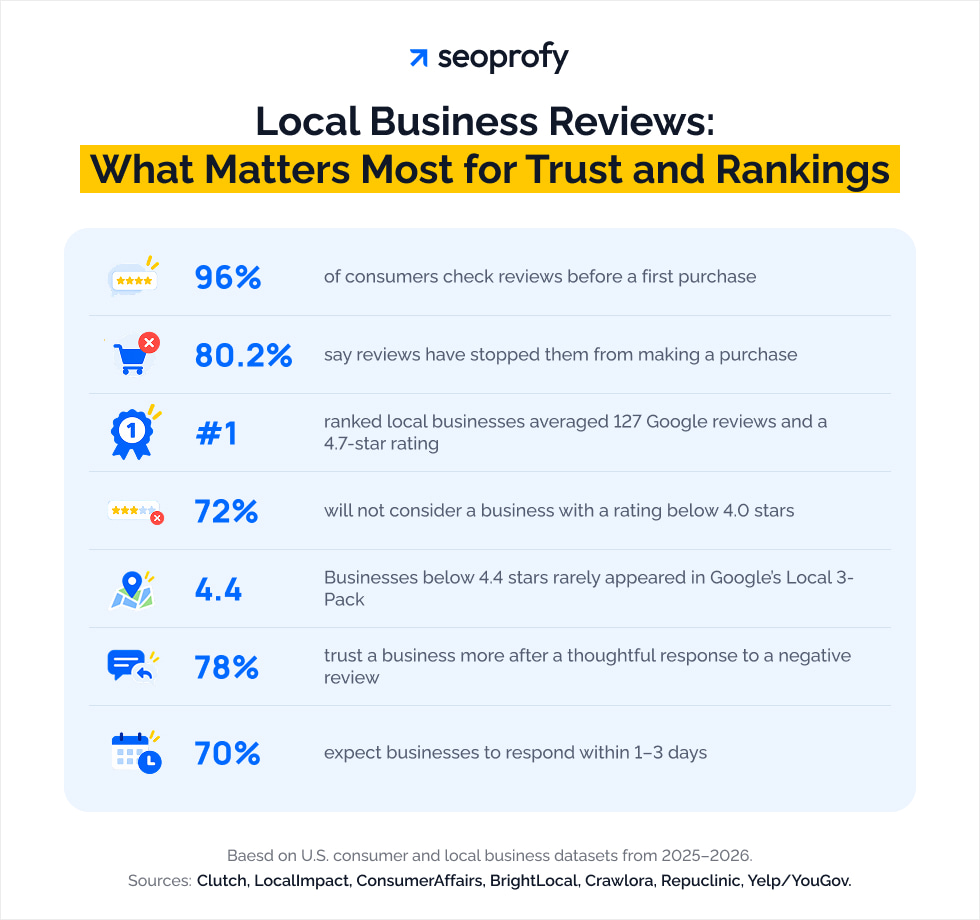
SEO statistics show that reviews not only shape potential customers’ perceptions of your business but also improve your local rankings. When people see positive reviews and how you respond to negative ones, they’re more likely to choose you over competitors. Still, in local SEO, businesses should focus on generating authentic reviews consistently and responding to feedback promptly instead of treating review collection as a one-time task.
- 96% of consumers check reviews before buying a product or service they have not purchased before. (Clutch)
- 92% of consumers read an online review in the past year, while 67% say they check reviews often or every time before making a purchase. (LocalImpact)
- 80.2% of Americans say reviews have influenced them not to make a purchase, and 37.6% become hesitant when an overall rating drops below 4 or 4.5 stars. (ConsumerAffairs)
- After an AI local-business recommendation, 34% of consumers cite star rating as their top purchase influencer, and 29% say review recency affects their decision. (Yext)
- 80% of consumers say they’re likely to use a business that responds to all of its reviews, while 42% are unlikely to use one that ignores reviews entirely. (BrightLocal)
- 23% of review writers use AI at least sometimes to help write reviews, yet 64% of consumers say AI-written reviews do not feel authentic. (Bazaarvoice)
- 78% of consumers say a thoughtful response to a negative review makes them more likely to trust the business, and 70% expect businesses to respond within one to three days. (LocalImpact)
- 10.1% of the 18.1 million U.S. Google Business Profile listings analyzed in July 2026 had never received a single review. (Crawlora)
- 72% of consumers will not consider a product or service with an average rating below 4 stars, while only 15% trust star ratings without additional review content. (Clutch)
- 84% of consumers are more likely to trust and ultimately buy from a retail brand with a representative review TrustScore; displaying review trust signals on-site increased purchase propensity by 9%. (Trustpilot/London Research)
- 88% of people who use reviews to evaluate local businesses trust these reviews containing written feedback more than star ratings alone. (Yelp/YouGov)
- Businesses with ratings below 4.4 stars rarely appeared in Google’s Local 3-Pack in a Q1 2026 study of around 1,400 local service businesses across 20 U.S. cities and seven categories. (Repuclinic)
- #1-ranked local service businesses in competitive markets averaged 127 Google reviews, while the median star rating among #1 results was 4.7. (Repuclinic)
Final Thoughts
From what we can see in our SEO statistics for 2026, the core factors that shape local visibility remain familiar. Relevance, distance, prominence, a complete and updated GBP, reviews, locally relevant website content, and authoritative links all contribute to how businesses appear in local search.
AI search is growing, but it has not replaced traditional local results. Only 7.9% of local search queries triggered a Google AI Overview, although the impact can be significant when one appears: the top-ranking organic page sees an average click-through rate about 58% lower. As this trend happens, businesses will need to focus more on tracking impressions and overall presence in search results rather than visits alone.
With all this data and tips we shared along the way, you are well-equipped to start improving your local SEO and drive more traffic to your business website. In case you need an expert’s eye for your local strategy, we are here to help.
At SeoProfy, we have a team of over 100 experts and provide local SEO services to help brands drive more nearby customers. We’ll improve your Google Business Profile, optimize pages with relevant local queries, and build high-quality backlinks so that you can see better rankings and higher ROI.
Book a free consultation to speak with our team today, and let’s create a strategic local SEO campaign personalized to your needs.

As a Content writer at SeoProfy, Hanna Zhytnik creates SEO content grounded in research, data, and ongoing hypothesis testing. With more than 5 years of experience across B2B, SaaS, and ecommerce, she brings both breadth of knowledge and a sharp focus on modern search. Her strength lies in turning complex experiments into clear explanations, bridging the gap between deep SEO practice and accessible content.